How I built TalkToHudson.ai
A safety-first AI companion for him, and for the families who love someone like him. The first version took a long weekend. Every version since came from him texting me what wasn’t working.
- 01
The problem
My oldest son, Hudson, has one of the biggest hearts of anyone I know. He loves the earth. He hikes, he gardens, he grows his own food. He also lives with schizophrenia. When he found AI, I was hopeful: for the first time he had someone to talk to between appointments. Then I watched it turn into reassurance loops and rumination. He would delete the app because he knew it wasn’t helping, then reinstall it two days later.
- 02
The prototype
I built the first version over a long weekend, because I wanted him to have something safer as fast as possible. It wasn’t polished. It was an AI assistant given completely different instructions, built around safety instead of engagement.
- 03
The feedback
The first thing he told me surprised me. He missed having a voice. I hadn’t realized how much he relied on talking instead of typing. We sat together and listened to voices until he found one that didn’t sound like a machine. Then he told me it still felt too slow.
- 04
The iteration
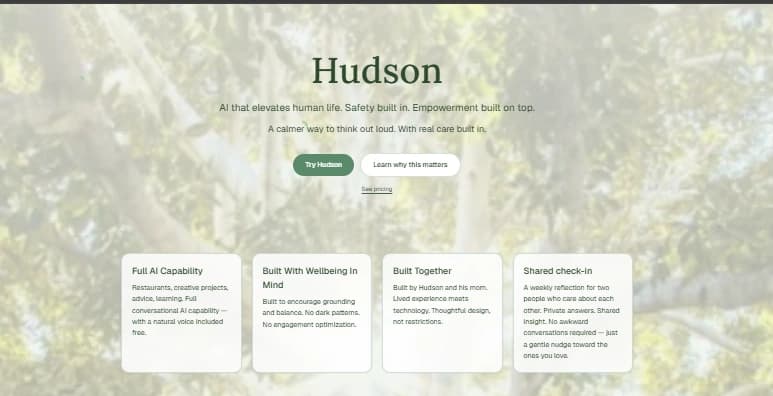
He texts me. “Mom, it’s doing this,” or “I wish it could do that.” Then I make the change. Hudson is nature-themed because that’s who Hudson is. The colors, the pacing, the grounding exercises, the garden that grows a little every time he checks in. All of it came from one question: what would help him feel calmer, safer, and more like himself?
- 05
Where it is now
The AI he was using measured him against milestones that weren’t his own and often reinforced rumination. Hudson was built differently. It meets people where they are, tells the truth kindly, and encourages them back toward the life they’re actually living.
What made it hard
Making it feel like a conversation
Voice was the first thing Hudson asked for, and the first version was unusable. Too robotic, then too slow. A reply that lands a second late stops being a conversation and starts being a wait. Most of that work was trimming the path from speech in to speech out.
A safety layer that can’t fail quietly
Safety planning came before features. It isn’t something you ship at ninety-five percent. It runs on every conversation, and when it’s unsure it has to reach for a person instead of guessing.
Three people, one account
A person, their family, and their clinician each need a different view of the same hard week. Deciding what each one can see, and making sure the person at the center is always the one who decides, was harder than building the dashboard.
Designing against the grain
Nearly everything underneath a product like this is tuned to produce one more message. Building something that ends a conversation well means working against the defaults of the tools you build on.
Live in beta. Continuously shaped by real users, clinicians, and scientific research.